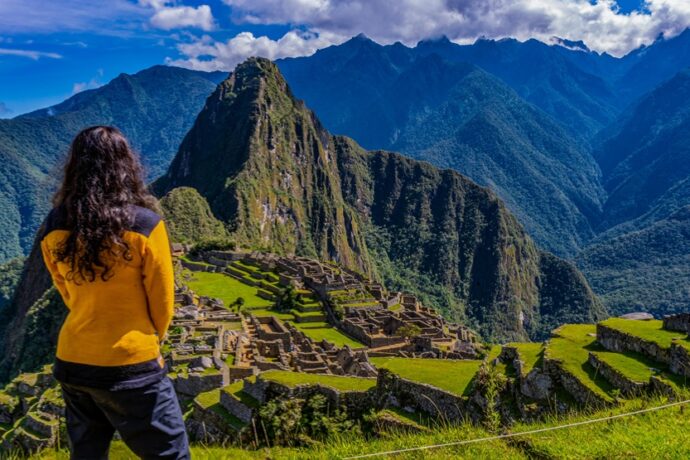
Cusco is not just the starting point to Machu Picchu. This city, situated at 3,400 meters (11,155 feet) above sea level, functions as the nerve center of some of the most challenging and transformative treks on the planet.
Compare rates at 103 currency stores in 34 cities (free service)
The trails that depart from here are not simple tourist routes: they are experiences that connect directly with Andean heritage, challenge physical limits and redefine what it means to explore.
The geography of the Peruvian Andes combines glaciers, tropical jungle, lakes of impossible colors and archaeological sites that have remained intact for centuries. Some of these treks confront you with the silence of the puna, others force you to trust in your endurance when there’s no breath left.
But they all have something in common, they don’t just take you to a destination, they transform you along the way. If you’re looking for more than a postcard of Machu Picchu, this guide is your starting point.
Classic Inca Trail
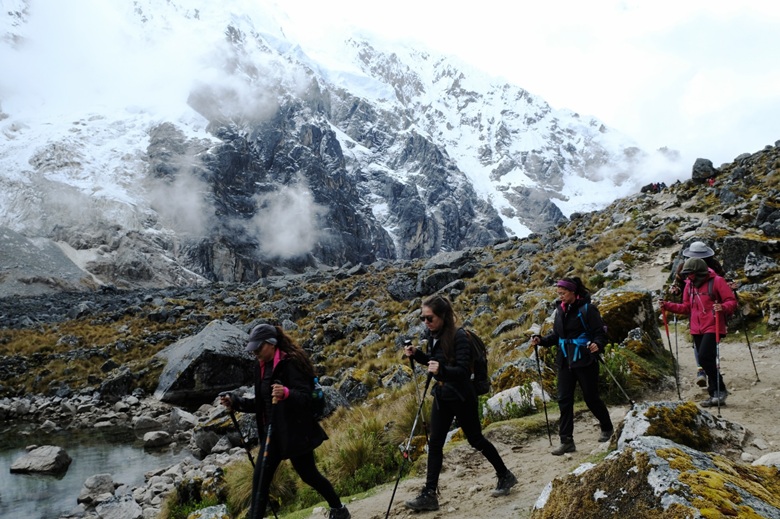
Inca Trail Macchu Picchu
- Distance: 42 kilometers (26.1 miles)
- Maximum altitude: 4,215 meters (13,829 feet) (Abra de Warmihuañusca)
- Cost: $650-1000 USD per person
- Reservation: Mandatory with a minimum of 6 months in advance
- Limit: 500 people/day (including guides, porters and cooks)
- Duration: 4 days/3 nights (classic) or 2 days/1 night (short)
Compare rates at 103 currency stores in 34 cities (free service)
The Inca Trail is Peru’s most famous trekking route and one of the most iconic in the world, because it connects directly with Machu Picchu following the original layout that the Incas built more than five centuries ago. Inca Trail to Machu Picchu is a historical journey through a system of royal roads designed to unite the empire.
Along its 42 kilometers (26.1 miles), this route traverses changing ecosystems, from high jungle to Andean puna and reaches heights of more than 4,200 meters (13,780 feet).
Along the way, key archaeological sites are visited such as Runkurakay, Sayacmarca, Phuyupatamarca and Wiñay Wayna, all connected by original pre-Hispanic stone paths.
What makes the Inca Trail unique is that it ends at the original entrance to Machu Picchu: Inti Punku, the Gate of the Sun. From there, the citadel appears through the mist at dawn, as travelers did centuries ago.
Access is limited to 500 people per day, including porters and guides, so it’s recommended to book up to 6 months in advance.
Choquequirao: The remote sister of Machu Picchu
- Total distance: between 58 and 64 km (36-40 miles) round trip (depending on the exact route)
- Altitude of archaeological site: 3,050 m (10,007 feet) a.s.l.
- Accumulated elevation difference: more than 1,500 m (4,921 feet) of descent and ascent per section
- Recommended duration: 4 to 5 days minimum (up to 9 if combined with other routes)
- Visitors per day: between 10 and 60 people (average below 50)
- Estimated cost: between 300 and 650 USD per person (depending on group and operator)
- Difficulty level: advanced, requires good physical condition and acclimatization
Choquequirao is an Inca citadel built high in the Apurímac canyon, considered the sacred sister of Machu Picchu. But here there are no trains or crowds.
It can only be reached on foot, in a demanding journey that crosses some of the wildest landscapes of the southern Andes. That difficulty is precisely what protects its authenticity.
The trek involves descending more than 1,500 meters (4,921 feet) to the Apurímac river and then ascending through steep sections to 3,050 meters (10,007 feet), where the archaeological site is located.
The complete route borders 60 kilometers (37.3 miles) round trip, and traverses changing climates, demanding slopes and basic campsites. In return, it offers a pure Inca experience, without filters.
It’s estimated that only between 30% and 40% of Choquequirao has been excavated. What is seen (agricultural terraces, channels, ceremonial plazas, dwellings) is barely a fraction of what remains hidden under the vegetation.
Visiting this site is, today, the most direct way to connect with the Inca worldview without intermediaries. On average, fewer than 50 people arrive each day. There is no easy access, and that makes it a real and transformative experience.
Salkantay Trek
- Total distance: about 74 km (46 miles) in five days
- Maximum altitude on route: 4,600 m (15,092 feet) (Salkantay Pass)
- Snow-capped peak altitude: 6,271 m (20,574 feet)
- Costs: between 500 and 800 USD per person, varies according to group size and operator
- Duration: between 4 and 6 days, five is recommended
- Ecosystems: glacier / puna / cloud forest / tropical jungle
- Difficulty level: intermediate to advanced, requires good physical condition and acclimatization
- Permits: not required for the route, only the ticket to Machu Picchu
- Visitors per day: average around 50, no quota limit
The Salkantay Trek is one of the most powerful and complete alternatives to the Inca Trail. It usually begins in Soraypampa, near the glacial peaks of the Salkantay and Humantay snow-capped mountains, and in four or five days takes you to Machu Picchu traversing extreme ecosystems: glaciers, puna, cloud forests, warm valleys and tropical jungle.
The highest point of the trek is the Salkantay pass, at about 4,600 meters (15,092 feet), where the magnitude of the sacred mountain becomes palpable. From there, the descent towards the tropical valleys is extreme, going from nights below zero (32°F) to humid heat in the jungle. It doesn’t require special permits, only the entrance ticket to Machu Picchu, which makes it an excellent option when the Inca Trail is full.
This trek is considered intermediate to advanced difficulty. It requires good acclimatization and healthy physical condition. Generally around 74 kilometers (46 miles) are covered in five days.
The cost varies between 500 and 800 dollars per person, according to the operator, included services and group size. It ends in the town of Aguas Calientes, the closest to Machu Picchu, and from there you access the citadel.
The experience stands out for the constant change of landscapes and the transformation it generates in those who complete it.
Lares Trek
- Total distance: 33 km (20.5 miles) (classic route, 3 or 4 days)
- Maximum altitude: 4,450 m (14,600 feet) (Ipsayccocha Pass) depending on the chosen route.
- Estimated costs: 350– 700 USD per person, according to group and operator
- Recommended duration: 3 days minimum, up to 5 according to variant
- Difficulty level: intermediate, with three high passes and good physical condition necessary
- Highlight: hot springs at 3,800 m (12,467 feet)
- Key communities: Lares, Huacahuasi, Patacancha, Huilloc
- Permits: not required, only the ticket to Machu Picchu
- Visitors per day: little-traveled route, much less than the Inca Trail
The Lares Trek is a high mountain route that offers a real immersion in Andean culture. Unlike the Inca Trail, here there are no crowds, only Quechua communities that preserve textile, agricultural and pastoral practices with millennial roots. Walking the same paths they do is reconnecting with an authentic Peru.
The route covers around 33 kilometers (20.5 miles) in three days, reaches a pass of 4,450 meters (14,600 feet) at Ipsayccocha and descends towards traditional communities. It stands out for its natural hot springs located at 3,800 meters (12,467 feet), in the town of Lares.
Along the way you can appreciate birds, alpacas and Andean landscapes that accompany the daily journey and allow you to know genuine lifestyles.
The trek is intermediate level. It requires acclimatization, but doesn’t require permits. The cost usually ranges between 350 and 700 dollars per person, according to the operator, included services and group size.
It ends in Ollantaytambo, from where you take the train to Aguas Calientes and Machu Picchu. It’s an ideal option for those seeking a real cultural connection, with landscapes and Andean tradition.
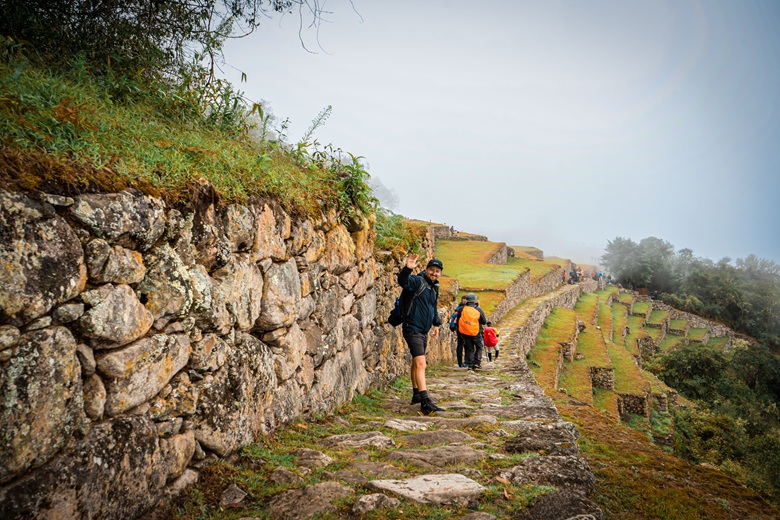
Final stretch before Machu Picchu Inca Trail
Inca Jungle Trek
- Cycling: 45 kilometers (28 miles) of descent
- Trek: 15 additional kilometers (9.3 miles)
- Maximum altitude: 4,350 meters (14,272 feet) (Abra Málaga)
- Cost: $300-700 USD per person
- Duration: 3-4 days
- Activities: Cycling, rafting, zip-lining, trekking
- Level: Easy to intermediate – oriented to adventure sports
This experience combines mountain biking, rafting, zip-lining and hiking, offering an intense journey through extreme and changing landscapes.
It begins at the Málaga pass, at more than 4,300 meters (14,108 feet) altitude, descends by bicycle to the vicinity of the town of Santa María, a descent of about 45 km (28 miles), and continues with rafting on the Urubamba river, then zip-lines and a trek towards Machu Picchu in a total of four days.
Its value lies in integrating recreation, adrenaline and culture in a single alternative route to the Inca Trail, ideal for those seeking physical excitement and natural connection before reaching the sacred citadel.
The highest point is the Abra Málaga pass, at approximately 4,316 m (14,160 feet), where the cycling descent begins on serpentine road. The climatic contrast is marked, initial low temperatures and tropical heat in the final sections.
It’s a complete adventure that impacts body and mind, and connects with the environment and Andean tradition in a unique way.
Summary Table
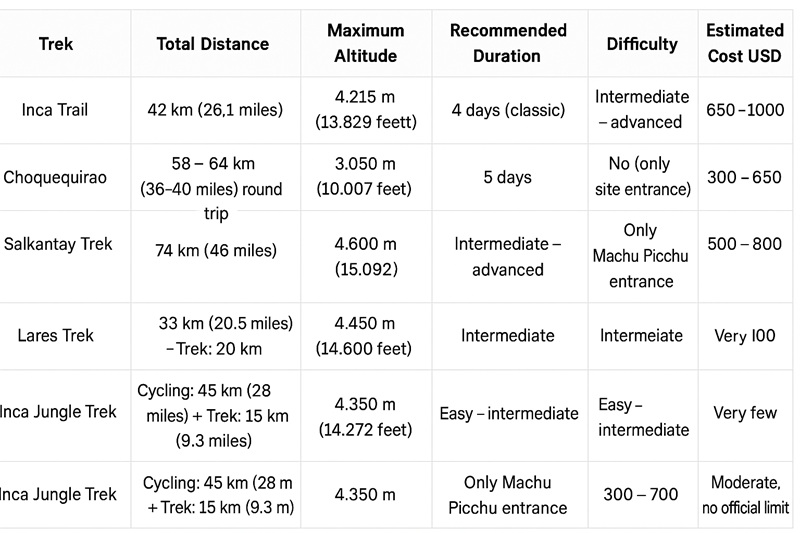
Summary table Inca Trail options
A decision that transforms life
These routes are not simple extensions of Machu Picchu. They are experiences with their own life that force you to understand the Andes from within. Each trail that surrounds the sacred citadel of the Incas has a different purpose.
The Inca Trail connects you with imperial history. Choquequirao demands physical commitment and returns a rawer vision of the Andean world. Salkantay pierces you with changing landscapes that give you no respite.
Lares invites you to look at the daily life of real Quechua communities. Inca Jungle pushes you to the body, to adrenaline and to another way of arriving.
Waman Adventures is your ally in this decision. As a certified local operator in Peru, with years of experience in high-altitude trekking and Andean culture, we provide you with authentic routes, expert guides and the logistics you need to focus on what’s essential: living the path.
If you’re ready to explore the Andes from within, discover our treks to Peru and Machu Picchu. Cusco is not just the starting point. It’s where journeys that leave a mark begin.
Other popular currencies
Best rate of the day (exchange euros to another currency)
Sin comentarios